Wednesday, May 31, 2006

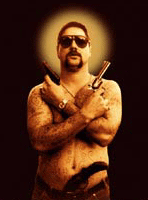
Chopper

Chopper by Andrew Dominik, 2000.

Chopper is my first taste of Australian Cinema since I have arrived in Sydney. I, of course, have seen other Australian films in years past (Mad Max anyone?) but this is probably one of the only recent Australian features that I have had to the chance to see up unto this point.

Forging a path that crosses genres, Chopper manages to blend elements of the crime/gangster genre with a nice splash of black comedy. The film is about the real Chopper (Mark Brandon Read) who seems to feel that it is his responsibility to dole out justice. While there is some question to what crimes Chopper actually committed and what he made up for the sake of publicity, there is no doubt that Chopper is a hardened criminal through and through.

The film opens with him giving an interview on TV and intercuts this with Chopper watching the same special from his jail cell. Obviously proud of himself, Chopper grins from ear to ear at each moment he feels is particularly brilliant on his part.

It is from this point that the film jumps back in time and follows Chopper's story until it completes the circle of ending where the film began. It is here that the film, on a technical standpoint, falls a little short. It is sometimes difficult to tell if what you are viewing is in the present, past, or a particular spin on a event that Chopper is narrating. In many films this is a purposeful narrative choice, but in the case of this film I came away with the distinct feeling that temporal confusion was not the desired goal of the director.

What truly carries this film, and causes it to stand on its own in the recent deluge of gangster/criminal films is the character of Chopper and the absolutely superb performance turned in by Erik Bana. No matter how crazy, cruel, and volcanically violent Chopper can be you can't help but find yourself still liking the character on some level. Chopper is also the source of the very dark humor that permeates the entire narrative. After stabbing a fellow inmate brutally in the neck several times Chopper stands back, as if in shock at his own actions, and then asks the inmate, "Are you ok? You're ok, right mate," and then proceeds to light a cigarette and try to give it him. The humor is somewhat lost in the translation from screen to my brief description, but it is this type of awkward, inappropriately absurd politeness that manages to make even the most brutal scene comical in its execution.

I found the film to be a completely thrilling story, all the more engrossing due to its foundation in real life events. If you aren't squeamish, and are in the mood for a gritty yet funny piece of cinema consider Chopper.
***Three Stars

Friday, May 19, 2006

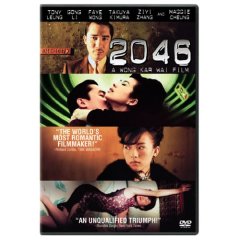
In the Mood for Love/2046 - Wong Kar Wai


Slow. Boring. Nothing happens. All style, no substance. I have seen these critizisms and others levied against the films of Wong Kar Wai. I couldn't disagree more.

For those unitiated in the world of Asian art cinema, it is understandable how people could come away with the types of feelings listed above. In a culture where we are inundated with Hollywood cinema and the traditional Hollywood narrative structure, films such as WKW's In the Mood for Love and 2046 would seem to be slow and monotonous. However in the canon of American cinema there resides those directors who approached the medium of film from a similar angle, if not through a similar means of execution. John Cassavetes immediately comes to mind.

Those directors who believe conflict, violence, and action are inconsequential to the power of the cinematic apparatus to focus, in minute detail, upon the basic existence of our lives on this planet. Much like Cassavetes, WKW's films focus on the emotional beats that play out ever so subtly in a moment of contemplative silence. The camera focusing on the face of an actor or actress as the a range of conflicting emotions washes across the character. Or how in a given scene the emotional range that is played upon, changing from instant to instant as two human beings try to navigate the always complex waters of interpersonal communication.

In the films In the Mood for Love and 2046, this plays out through a focus on the character of Chow Mo Wan (the superb Tony Leung). The reason why I have grouped these two films together is because they are, in essence, two halves of a whole. While each film can stand on its own, I highly recommend viewing In the Mood for Love before you see 2046, since the first film provides background and depth that enriches the viewing experience of 2046.

The story follows Chow Mo Wan as he discovers his marriage is not exactly as it seems and he sets out on a relationship with the woman who lives next door to him. Expertly playing on the tensions that come with the voyage into a new relationship, WKW leaves things ambigous as to the true nature of the relationship. 2046 picks up several years later as Chow Mo Wan is still working as a writer. The film jumps between him remembering the past, and writing a story set in the future. Again the focus is the male/female relationships that occur in the film.

WKW goes about telling these stories in a highly stylized manner. Even the films biggest protractors admit these are absolutely beautiful pieces of cinema. Using a pallete of lush, vibrant colors, WKW's framing of scenes plays out much like the soft brush strokes of a painter. Often making unique off center framing choices much of these films take on an overtly voyeuristic tonal quality. At times you feel like you are witnessing priveleged, private moments you shouldn't be.

WKW is also a fan of altering the frame rate. I personally feel that cinematic tricks such as slow motion are these days generally over used and heavy handed (The Passion of the Christ or Brotherhood of the Wolf anyone?), however WKW has a distinct flair for the technique. In a manner that calls up Brechtian philosophy, WKW will choose particular moments to slow the screen almost to halt. The choice of scene and its affect on pacing causes you to never truly be submerged in the filmic reality. Instead, he distances the audience through these techniques while simultaneously maintaining the delicate bubble of illusion that is the film. You are forced to stop and think about what you are witnessing unfold and yet you find yourself admiring the absolute beauty of the image before you.

No review of WKW's films would be complete without some mention of his use of music. Opting for quality over quantity, WKW carefully chooses 5 or 6 pieces of music that he will repeat throughout the film. Whether a certain piece marks a character or specific emotional moments, the repetition serves to create the sense of a tapestry being woven, distinct threads being woven together to form something else entirely. In reality, however, his music is not something that can truly be adequately described, rather it is something you need to hear for youself.

Godard is often mentioned as a major influence in WKW's films, and there is definitely something to be said for that. Wong Kar Wai himself has talked about that influence. However, I find myself more often noting elements of Ozu in WKW's work. The haunting sense of space, the lingering shots after the 'action of the scene' is over, the way the camera dolleys to the right or left, leaving the scene to focus on some aspect of the filmic space - all these seem to be subtle reminders of films such as Ozu's Late Spring or Tokyo Story.

So, if you're looking for the next big action flick, witty comedy, or typical melodrama...don't watch these films. If you're willing to give a shot to something that is incredibly foreign in its pacing, but incredibly rewarding in its payoffs, give them a shot. If you do and find they are just as boring as some people said, well don't blame me, and I won't blame you. After all 'To each their own'.
In the Mood for Love****Four Stars 2046*** and a half (four if you've seen In the Mood for Love prior to viewing).

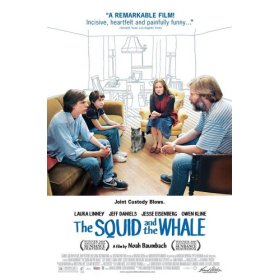
The Squid and the Whale - Noel Baumbach, 2005


Well here I am again posting about a movie months after it has left the theater. Sue me. I'm busy...with stuff...and things.

So I watched The Squid and the Whale for the first time last night. I'd been meaning to see it ever since I knew Noah Baumbach was the driving force behind the project. I have to say I'm sorry it took me this long to get around to the film.

Coming in at just under an hour and a half The Squid and the Whale is the perfect peak into the life of a family going through divorce. It is here that I have to admit that I am somewhat biased towards this film as I myself come from a family of divorce.

It took a short time for me to really get absorbed into the film, but slowly and surely the understated dialogue, and quick acidic humor seeps into you. Drawing you through the frame and into the lives of two kids, and mother and father who are at turns infuriating, funny, and sharply tear inducing.

I think ultimately what particularly won me over in regards to the movie is the disparate paths the two kids take in the film. One mimics everything his father does, swallowing what he has to say without bothering to question it. The other is resentful of his father and sides with the mother. Ultimately each discover that in these situations neither parent is 100% right or wrong....after all, as the saying goes, "It takes two to tango."

I could see how those who haven't personally experienced a family torn by divorce might not be able to relate to the characters in the same way, and ultimately find them frustrating, but if you have had personal experience in this arena, I highly recommend this film.
*** Three stars

Thursday, December 15, 2005

The Passenger (Professione: reporter)


The Passenger: Directed by Michelangelo Antonioni, 1975

I was priveleged to experience a rare treat last night. My friend and I travelled over towards MIT to the Kendall Square cinema to catch a special screening of Michelangelo Antonioni's The Passenger. The print was in excellent condition and it's not every day you get to see classic films such as The Passenger up on the big screen.

The Passenger centers on the character of David Locke, played by Jack Nicholson. Locke is a reporter and the opening of the film finds him in an unnamed little country in Africa where he is trying to wrap up a new documentary that focuses on the guerilla movements in the area. After a failed attempt to meet some of the guerilla's Locke returns to his hotel to discover that a friend he had made on the plane, Robertson, is dead. In a bizarre turn of events, Locke sets things up in such a way to make it look like it was he who had died and not Robertson. Armed with Robertson's identity, and aided by the fact that everyone believes Locke is actually dead, Nicholson begins to follow in the footsteps of Robertson.

It is at this point the film spirals off into confusing twists and turns that accuratley convey the sense of unkown and subtle layer of confusion David Locke must feel himself. The rest of the film follows Locke and his journey as Robertson, while periodically intercutting this journey with both past and present glimpses of his former life. By the end of the film, things have neatly been woven together, in what is at times, a humorous and suspenseful nod to the political thrillers that were heavily popular during the 1970's.

What makes this film worthwhile is how Antonioni does an excellent job of making this film about the character of David Locke. Why does he choose to let people believe he is dead? Why is he running away from a successful career and also his marriage? After he discovers what Robertson's profession is, why does he choose to continue Robertson's work for him? It is these questions and more that arise throughout the course of the film, and ultimately I don't think there is any one answer. It should be mentioned here that Nicholson does an excellent job with the role, saying more with less, commanding the viewers attention without any visible effort.

The other aspect of this film that makes it worth seeing is the cinematography. The film is simply beautiful. One realizes quickly that the environments of the film are as much a character as the actual people that populate the screen. Antonioni moves from one brilliant piece of architecture to another, all the while interspersing this architectural marvels with brilliant shots of landscape. In particular there is an amzing scene in which Nicholson is asked what he is running from. In response he says "Turn your back to the front of the car." Maria Schneider obliges him, and the camera shows an endless line of trees, all marked with white squares, quickly fading away as the car speeds onward. It seems like a simple shot, but on the screen the composition becomes quite poetic.

Not nearly finished, Antonioni save his best for last. There is an extremely long take right at the end of the film in which the camera is situated within a room. The camera ever so slowly moves in to focus on an old man sitting outside, across the empty road. The window in which this is shot through is covered with bars, yet uninterrupted, the camera moves through the bars and then slowly pans to the left. It then pans back to the right, making a full 360 degree turn and the dolley's and tracks to the left, framing the interior of the room the camera had just left. This entire shot is probably about 5 minutes and there is not a single cut. If someone can explain to me how this shot was pulled off (specifically getting the camera through the bars in the window) I'd love to hear it.

Ultimately the film is entertaining and thought provoking. What makes it stand out is its defiance to be confined to a single genre. Is it a travel film, political thriller, simple drama. All of them apply at one point or another. Nicholson's performance is probably one of his best, so if not for anything else its worth checking out the film to see Nicholson still in the earlier stages of his career (a full 5 years before The Shining).

***three stars

Saturday, November 12, 2005

Midnight Cowboy


Midnight Cowboy: Directed by John Schlesinger, 1969.

To me Midnight Cowboy is one of the all time classics of American cinema that has been all but forgotten.

The story is a simple one. Joe Buck (Jon Voight) is a small town Texan who seeks to escape the dead end dishwashing job he has by moving to New York to become a hustler. He's heard that New York is overflowing with women willing to pay for sex, and as he puts it "The only thing I'm good at is loving". Things don't work out as Joe plans and he ends up homeless, befriending another homeless man Rico 'Ratso' played by Dustin Hoffman.

The film operates on many levels but ultimately it deals with the pursuit of the American dream, making it big, and the dichotomy between mythical perceptions and the often harsh actualities of reality. Buck dreams of living the high life in New York while Ratso holds fantasies about the bounties of Florida.

At times hilarious, the film carries a very dark and sad mood that is always just a couple inches below the surface.

The performances are brilliant, while the direction, obviously influenced by the stylistic devices of the french new wave, does a superb job of guiding the film to it's heart wrenching ending.

It's a tale of having dreams shattered. It's a tale of friendship. It's a tale of the struggle for survival that at a base level everyone lives out each day. If you haven't seen this film, you owe it yourself to check it out. If you like the movie you should check out 'Marathon Man' and 'Day of the Locust' both of which are other excellent films directed by Schlesinger.

****Four stars

Wednesday, October 26, 2005

RAY


Ray: Talyor Hackford 2004

Yes I know. This review is a little bit late in coming, but I didn't actually get around to seeing the film until a few days ago so what can I do?

Honestly I debated writing a review for this film because I'm not sure how much I have to say.

By this point most people should know that the film is a biopic on the life of Ray Charles, although it actually focuses mainly on his early career and summarizes his mid and late life at the end of the movie.

As a biopic it has all the standard trappings of a film that would fall into this category. The film follows Ray's struggle to achieve his goals, in this case making it in the music industry, while intercutting to formative moments from his childhood. Once Ray makes it big he deals with the typical issues that come from fame and celebrity. You watch as he faces complications and issues until ultimately he overcomes these leading to the final resolution of the film and the previously mentioned summarizing of the rest of his career and life.

While most of the film was pretty standard fare, I was surprised by what an honest look the film takes at the life of Ray. There are not many punches held back in regards to his drug abuse and womanizing. Unfortunately the director chose to view these not on their own but framed by the contextual surroundings of Ray's life leading to a sympathetic and almost apoligetic view of what amounts to some pretty horrendous moments of Ray's life. That being said I don't think this ultimately overwhelms the film, it just lowers it a notch or two from what it could have been.

Jamie Foxx was heaped with accolades for his performance of Ray and this is not completely without merit. Foxx turns in an excellent performance and it was obvious he did some careful research before portraying Ray Charles. Still, I feel the amount of praise is somewhat overblown and unwarranted because ultimately the role is fairly simple. One has to wonder if Jim Carrey is still cursing the academy for nominating Foxx while his brilliant, and much more difficult portrayel of Andy Kaufman and his alter-ego was completely ignored.

In closing, the film is definitely entertaining and even informative about the life and character of Ray Charles. I'd recommend it highly as a good rental, but I still feel the Oscar recognition was unwarranted.

** two stars.

Thursday, October 20, 2005

Weekend


Weekend
Directed by Jean-Luc Godard 1967

I have to preface this review by saying Godard is one of my favorite directors. He never fails to entertain yet stimulate the mind with the ideas he puts forth through his films.

That being said, Weekend is one of the best movies I have seen. It is not for everyone though. Weekend is very abstract, blurring and distorting time, continuity, plot, and just about anything else you can think of.

Mereille Darc plays Corinne and Jean Yanne plays Roland. The film is loosely structured around the story element that Roland is attempting to strike it rich off of Corrine's father who is about to die. They attempt to go to Corrine's father before he dies and insanity insues.

Godard admittedly said that one aspect of this film was designed to shock the audience, and by the content of the film this attempt is very obvious. From frank sexual discussions that still seem shockingly pornographic even by today's standards, to scenes of cannabalism decorated with a blood soaked chef sticking eggs and fish between a woman's legs before they eat her, shocking imagery and content abounds.

Focusing purely on those aspects would guarantee that you would miss the point and the pure fun, sometimes strikingly black humor that permeates the film.

As you may guess Corrine and Roland run into many obstacles in trying to reach her father. Through this obstacles the film spins off in directions that operate on both philosophical and sociological layers.

Class, gender, and racial issues abound, but nothing strikes more home then the scathing critque of the then socio-political culture that pervaded society at the time and is still prevelant today.

A telling moment in the film revolves around the statement of one character who suggests that the horror of the bourgeoisie can only be realized by showing it and then showing more horror. Working off of that statement you can divide this film into two parts: the first part being the outlining of the horror of the bourgeoisie and the second part being an extreme absurdist take on the bourgeoisie that consequently adds more horror.

Despite this Godard manages to maintain a level of entertainment and humor that is combined with the powerful urge to follow a narrative that is spun in such a way that the audience is left constantly guessing at what will happen next.

You never really are asked to relate to the characters, but Weekend is a rare instance of a film that a connection with the characters is not a requirement for the thourough enjoyment of the film.

If you're willing to expand your boundaries while putting up with potentially offensive content that serves a much deeper purpose, you owe it to yourself to watch this film.

**** Four stars

Saturday, October 15, 2005

The Servant

The Servant(1963) directed by Joseph Losey

It is difficult to know where to start with Joseph Losey's brilliant film The Servant. Perhaps a little background information Joseph Losey is in order.

Losey was a victim of the McCarthy era, relegated to England under the pressure of being blacklisted and the prevalent political climate of the time. The vast majority of his work would be categorized within the B movie genre, but despite the limitations he faced, his films often far exceeded the B movie label. Not very well known, even among those fairly knowledgable in film, Losey is the director's director. The likes of Scorcese, Godard, Kubrick, and Quentin Tarrentino all make reference to Losey as being a masterscraftsmen and for some a major influence in their own work. Of all the films Losey made, The Servant is one of his best.

The film focuses on 4 characters. The two male leads are played by James Fox(Tony) and a Losey favorite, Dirk Bogarde(Hugo Barrett). The female leads are played by Sarah Miles(Vera) and Wendy Craig(Susan).

The plot centers around the relationships of these four characters. Specifically, Barrett is hired by Tony to be his "man servant". Barett moves in, and slowly takes over the entire house. Trouble ensues as everything is not as it seems with Barett's sister Vera, and Tony's fiance Susan becomes increasingly threatened by Barett's intrusion into Tony and her's life.

The plot, however, is merely surface material for the actual content of the film. Through the direction of Losey almost everything is left in doubt for the viewer. Is Vera really Barrett's sister? Are the events actually taking place or is this just a dream, or even a play of the mind? Is Barrett or Tony real? One could easily argue that either of them is merely an apparition, a figment of the mind of the other.

Losey makes masterful use of the resources available to him, constructing the entire house that most of the film is shot in. During the film he actually plays with the dimensions of the house, moving walls in and out, changing spacial relationships and creating a sense of disorientation for the viewer.

There are multiple moments within the film, that if you stop to consider what you are viewing, you will find yourself questioning how in the world Losey managed to actually make the shot, since it is seemly implausible that the camera would not be visible in some fashion.

It is a drama in the highest order and it pulls you in as it follows the apparent collapse of Tony into a state of potential mental instablility. Then again, maybe Tony is simply an aspect of Barrett's mind. That decision is left up to you.

*** 1/2 Three and a half stars

Friday, October 14, 2005

Domino Review

Tony Scott is a true directing enigma. He is certainly talented and yet has never been able to find consistency throughout his career which has resulted in a filmography that reads like a list of action film does (The Hunger, True Romance, Man on Fire) and don'ts (The Fan, The Last Boy Scout, Days of Thunder). Unfortunately, while not a complete loss, Domino falls in to the later category.

The opening is nice enough to point out that the film is "Based on a true story. Sort of." While the "Sort of." points out the fact that the filmmakers are taking extensive creative license, half way through, the film has reached such a point of convoluted excess that the "Based on a true story." carries no weight.

*WARNING: MINOR SPOILERS*

It starts out easily enough with Domino (Keira Knightley) being questioned by an FBI agent (Lucy Liu) regarding an assignment that went wrong. The narrative then launches into a start from the start flashback (of course the whole movie is a flashback) in which Domino, in constant voice over, relates the events of her childhood, first amongst them being the death of her father, Laurence Harvey (The Manchurian Candidate). The screenplay hints at the fact that she was very close to her father but speeds past it so quickly that the death of a goldfish that her father bought her seems to carry more weight than the loss of her father. After the death of her father, her mother's (Jacqueline Bisset) chief occupation becomes finding another rich man to marry and to do so she sends Domino to boarding school which propels her into the world of the rich that she has no desire to be a part of. Domino continues on this "90210", sorority, modeling path at the insistence of her mother but rebels any chance she gets, which is manifested in her practicing the use of weapons such as knives and throwing stars and also punching people in the nose (which seems to be her favorite thing to do). This culminates in her being expelled from college with a bad case of teen angst that she can't seem to shake.

Aimless, with a desire to appease her badgirl tendencies, Domino chances across an add for a bounty hunter seminar and decides that this is right up her alley. At the seminar, which turns out to be a scam, she meets Ed (Mickey Rourke) and Choco (Edgar Martinez) when she accosts them in an alley while they are fleeing with the $100 entry fee they charged everyone for the seminar. She convinces them that she can apparently give Michelangelo of the Teenage Mutant Ninja Turtles a run for his money with nunchucks and they reluctantly decide to let her tag along. She begins to go on jobs that Ed and Choco do for a bail bondsman (Delroy Lindo) and they somehow catch the attention of a TV producer (Christopher Walken) who wants to make a reality show out of there exploits.

With the TV crew and the shows hosts (Ian Ziering and Brian Austin Green of '90210' fame)following along, our bounty hunters get caught up in a scheme involving the theft of $10 million dollars from the owner (Dabney Coleman) of the Stratosphere Hotel and Casino in Las Vegas. This is where the plot just gets unnecessarily convoluted and while I might be remiss in not getting into more detail with it, I'm just feeling too lazy to attempt to decipher it into some coherent explanation. Besides, relaying any more detail is fruitless because the plot points are largely arbitrary and function as nothing more than filler for the thin script. I will say that it culminates in a shootout at the Stratosphere that dimly echoes the climax of Scott's far superior film, True Romance.

Woo, ok, so all of that 'plot' stuff is out of the way.

The film is full of promise and certainly has some entertaining moments, but ultimately turns out a mess due in large part to Scott's direction. He has a very interesting style that is one step beyond that of the flavor-of-the-week music video director that is usually employed for action films, but it just does not function here. While in Man on Fire, Scott's growing fondness for franetic editing, repetition of lines, and subtitles functions wonderfully in relation to the narrative and characters, in Domino, it's painfully dominate and severely hampers the film. He just couldn't seem to find any restraint.

One of the more unfortunate parts of the film is that Knightly actually is very good, but she really has nowhere to go with the material. As a result, Domino is a character full of bravado but nothing else. There are some forced attempts at character depth such as a moment where Domino gets to play Robin Hood and the hardly developed, somewhat violent attraction Choco has for her which could have been great material to get into for both characters. The two actors that really do shine throughout are Mickey Rourke and Christopher Walken. Rourke, who's career has recently received a boost from Scott and Robert Rodriguez (most notably as Marv in Sin City), is excellent as the weathered lead bounty hunter. And Christopher Walken, well, he's Christopher Walken. Walken is one of the few actors I can think of who can deliver the line "Sorry, I'm having font issues." (no, that's not a typo) and make it work.

Despite all of the bad though, the film does certainly have some entertainment value and the aforementioned performances make it worth seeing. It's definitely to be reserved for the dollar theater or a rental though.

* 1/2 stars

Ok, thus ends my first attempt at a film review. Hopefully it wasn't too painful for you to get through (if you did get through it)!

Thanks for checking in and please keep doing so if you like our reviews so far!

Wednesday, October 12, 2005

Serenity Review


Just wanted to echo Brodie's hello! /Serenity review

Now on to business.

Serenity:

Talk about a fun film. For those of you not familiar with the TV series Firefly, Serenity is a continuation of the show which was tragically cancelled after only a few episodes by the same geniuses at FOX who cancelled Babylon 5 and The Family Guy (twice!).

The story centers around a crew of renegades who spend their time on the "outer rim" making a living taking any jobs that come their way - legal or illegal. There is the captain Mal(Nathon Fillion), a quick witted, scrappy individual who presents a tough exterior but occasionally lets his softer, more empathetic side show through. His "first in command" is Zoe(Gina Torres) who served with him in the war and nows how to get things done. Other crew members include Kaylee(Jewel Staite) their female engineer who isn't as innocent as her smile would lead you to believe, Wash(Alan Tudyk) the funny but nervous pilot of serenity, Jayne(Adam Baldwyn) a slow-witted "tough" who really isn't all that tough, Inara(Morena Baccarin) a "companion"(professional prostitute) who is far more than meets the eye, Shepherd Book played by Ron Glass, and finally Simon and his sister River (Sean Maher and Summer Glau).

Without giving any of the plot away, Serenity is basically the story of how the crew of Serenity try to avoid the clutches of an operative and the alliance because Simon' s sister may know a secret that could bring the Alliance to it's knees.

The script is well written and the movie is well paced. You are never too overwhelmed with action or special effects, rather Joss Whedon finds a nice balance of suspense and action countered with witty dialogue and an interesting story. The film has a good sense of humour and it never takes itself too seriously.

This is not to say the movie is simply fluff. It actually can be seen to have some bearing on the current socio-political climate within the U.S. but never so much so that it blatantly beats you over the head.

One of my favorite aspects of the film is that it doesn't dwell to long on the emotional components within the movie. If it's one thing I can't stand, it would be when a movie hams up the emotional aspects complete with the standard Hollywood soundtrack that might as well be replaced with an voice-over that states "You should feel sad now. Here is where you should get the message of the film" etc etc. There are a few moments, and you will know the ones I am talking about when you see the film, that are strongly emotionally involving, yet they are over before you are allowed the time to process what you have just witnessed.

Overall I would say Joss Whedon did an excellent job with this sci-fi, spaghetti western. If you haven't seen the TV show, don't worry, most of those I have talked too have mentioned that they had no problem getting into the film despite the lack of background information the show provided. If your looking for a fun romp in space, filled with western frontier towns, assassins, quick dialogue, and bountiful laughs take a look!

*** Three stars

Monday, October 10, 2005

Hello! Just wanted to attempt some sort of welcoming to our site so people know (if anyone's actually looking) that we are indeed going to be posting. First and foremost, please excuse all spelling and grammatical errors that may, and most likely will, occur throughout our posts. Although we both have English degrees, that really just means our checks cleared. As Grinth stated on his other blog, we don't by any means intend this to be some Mecca for intelligent and/or profound statements on film. We both just thought it would be entertaining to take a crack at reviewing and hopefully we elicit some response whether it be "Hey, I think I'll check that out," or "Wow, these two really are morons." Either way. Also thought you might like to know that while we will be doing co-reviews, there won't be the entertaining point/counterpoint of an Ebert and Roeper where when they disagree they fall just short of yelling "Dammit! You just don't know what you're talking about you Sonuva 'B'!" (this is a family friendly site). Unfortunately, we agree more times then not and when we do disagree we regrettably tend to discuss it rationally and each present our points. Anyway, we should have some reviews posted any time now! I know we'll enjoy it and we hope you do too!